
The word “cryptocurrency” literally means “hidden” or “secret” money, but for most its history, the industry has largely treated privacy as an afterthought. Until very recently.
Over the past few weeks, we have seen a resurgence in the privacy narrative. Zcash (ZEC), one of the oldest and best-known privacy coins, is +700% since September, and it suddenly feels like everyone in crypto is a privacy expert. Some prominent Bitcoin voices have called the rally “artificial” and warned that buyers will become “exit liquidity” (a term referring to late entrants left holding the asset after others sell). Specifically, economist Lyn Alden has cautioned investors not to fall for "coordinated token pumps." Investor Naval Ravikant quickly countered with a fundamental argument for Zcash, saying “transparent crypto won’t survive a government crackdown.”
Remember: Satoshi Nakamoto, Bitcoin’s pseudonymous creator, acknowledged the network’s privacy limits in the 2008 whitepaper.

While CoinJoin implementations such as Samourai and Wasabi were once popular on Bitcoin, they have faced mounting regulatory pressure. Samourai was effectively shut down following the arrest of its founders, while Wasabi discontinued its CoinJoin feature in June 2024 and began blocking U.S. users amid regulatory concerns.
Payjoin is a simple tool that breaks the multi-input ownership heuristic described by Satoshi and appears to be gaining traction, but it still requires interaction between users. In the passage above, Satoshi is describing a broader issue with Bitcoin’s transparency. The multi-input heuristic assumes that all inputs for a transaction come from the same owner. This heuristic allows blockchain analysts to trace flows and cluster addresses with reasonable accuracy. Zcash, launched as a Bitcoin fork, allows users to shield transactions with zero-knowledge proofs, directly addressing the broader privacy limitations Satoshi acknowledged.
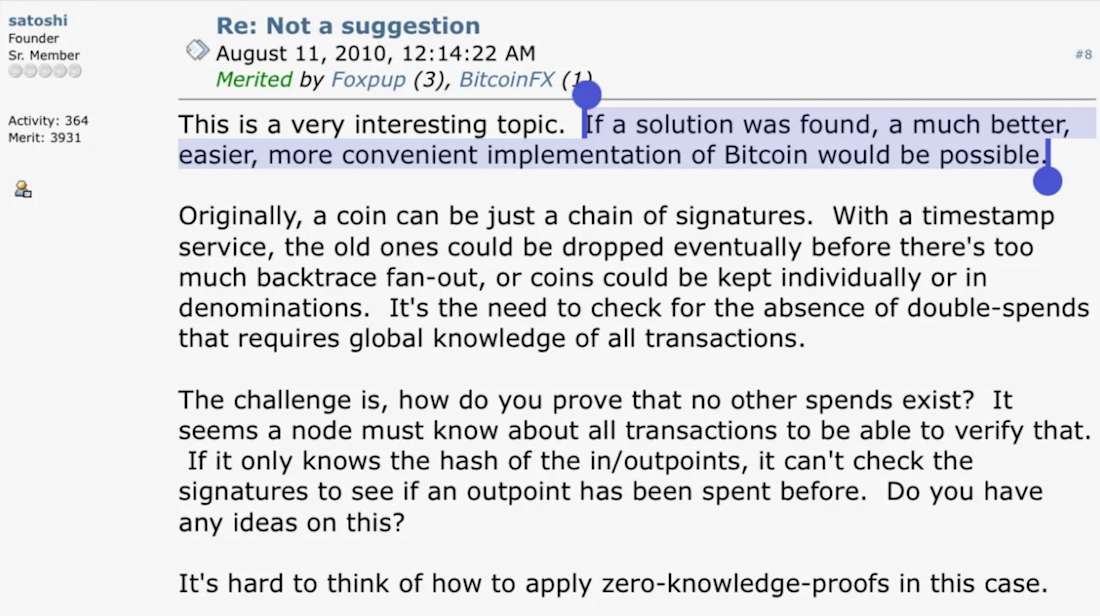
Satoshi acknowledged Bitcoin’s privacy limitations in a forum post.
Key Takeaways
- After years of languishing, ZEC has surged ~8x in the past month, outperforming the broader market and forcing a fresh conversation about privacy as a feature.
- The discourse mirrors Bitcoin’s early debates about the right to privacy vs. the reality of regulation.
- Zcash has overtaken Monero in market capitalization.
- Zcash’s UX has improved (see Zashi wallet).
- Cross-chain intent rails reduce friction (NEAR Intents).
- The anonymity set is expanding.
- For the first time, >30% of ZEC supply sits in shielded pools.
- Zcash still has a small node footprint relative to Bitcoin.
History and Network Upgrades
Zcash traces its roots to academic research in 2013, when cryptographers at Johns Hopkins University developed the Zerocoin protocol. The design later evolved into Zerocash, and eventually Zcash, as researchers sought to overcome the computational intensity and inefficiency of the original approach.
Zcash launched in 2016 as a privacy-focused fork of Bitcoin, created by cypherpunk Zooko Wilcox and his Electric Coin Company. The goal was simple: preserve the monetary DNA of Bitcoin while fixing its most-cited design gap (and one that Satoshi himself acknowledged): the lack of transactional privacy.
Unlike Bitcoin, where all transactions are publicly visible onchain (see mempool.space), Zcash uses a specific class of zero-knowledge proofs known as zk-SNARKs (zero-knowledge, succinct, non-interactive arguments of knowledge). These allow users to prove a transaction’s validity without revealing sender, receiver, or amount. While Monero launched earlier and employs privacy-preserving cryptography through rings signatures, stealth addresses, and Bulletproofs, Zcash was the first major blockchain to implement zk-SNARKs at the protocol level.
Zcash operates under an onchain funding model that allocates a portion of block rewards to community-directed initiatives rather than to specific organizations. Under the proposed ZIP 1016 framework, 8% of block rewards fund Zcash Community Grants (ZCG), while 12% accrue to a Coinholder-Controlled Fund governed by coinholder voting. Neither the Electric Coin Company (ECC) nor the Zcash Foundation receives an automatic share; both can apply for grants through these mechanisms.
Zcash has undergone several network upgrades (NUs) over the years:
- Sapling (2018) - introduced significant efficiency improvements for shielded transactions.
- Heartwood (2020) - introduced shielded (small-c) coinbase, letting miners receive block rewards privately.
- Canopy (2020) - coincided with the first halving and overhauled Zcash’s funding model, replacing the original founder’s reward (part of which went to early investors) with a four-year Dev Fund governed by the ECC, Zcash Foundation, and community grants.
- NU5 / Orchard (2022) - the most important milestone since launch, replacing the elaborate trusted setup ceremony with Halo 2’s recursive proofs and adding Unified Addresses (UA) that unify transparent and shielded receivers. Launch of Orchard shielded pool.
- NU6 (2024) - implemented in-protocol lockboxes to decentralize treasury management and improve transparency around how development funds are held and disbursed.
A full list of the network upgrades can be found here. Next, the protocol is preparing NU7.
For most of its life, ZEC has traded poorly, underperforming BTC and overshadowed by Monero, which provides every user with a baseline level of privacy by default but relies on small, decoy-based anonymity sets. Monero’s ring-signature design mixes each real input with 15 decoys, creating modest anonymity sets that have been partially deanonymized in research.
Regulators tend to scrutinize Monero (XMR) more heavily because its privacy is mandatory by default; in 2020, the IRS’ Criminal Investigation division even issued a contract to Chainalysis and Integra FEC to research methods for tracing Monero transactions. Zcash, by contrast, implements optional privacy through zk-SNARKs, which fully encrypt data and produce larger anonymity sets when shielded addresses are used.
Its bimodal design makes it easier for users to commit opsec mistakes such as transacting from transparent addresses, but given consistent opsec, Zcash’s cryptography provides materially stronger and more mathematically sound privacy. Zcash’s privacy layer is also quantum-resistant, whereas Monero’s current ring-signature scheme is not. Monero developers have acknowledged this limitation and plan to address it through future upgrades such as FCMP++.
Today, just the price of ZEC shows us a completely different narrative.
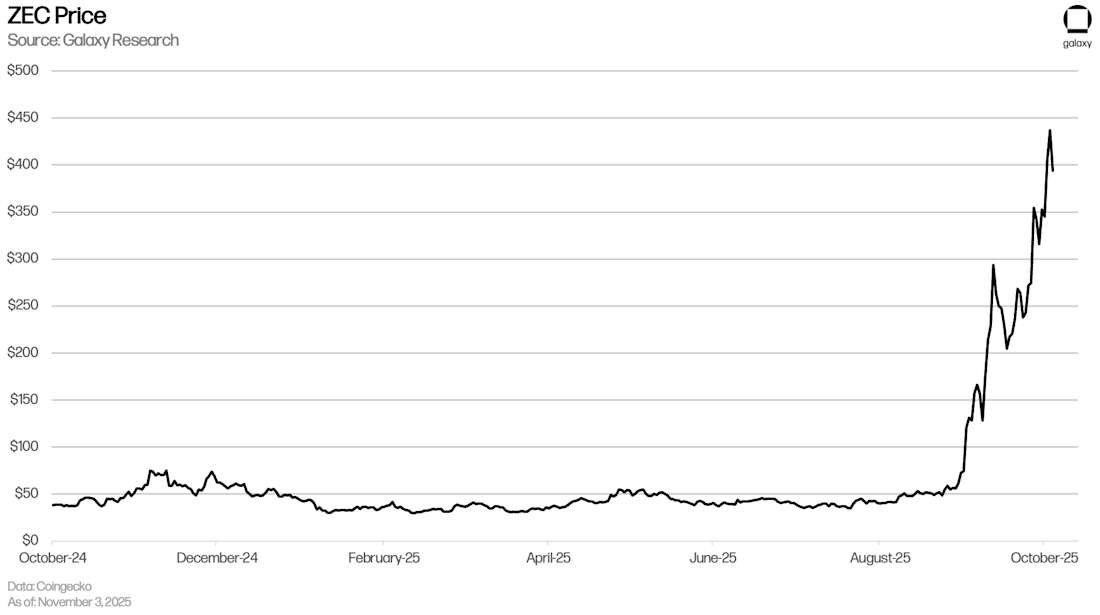
ZEC price over the past year.
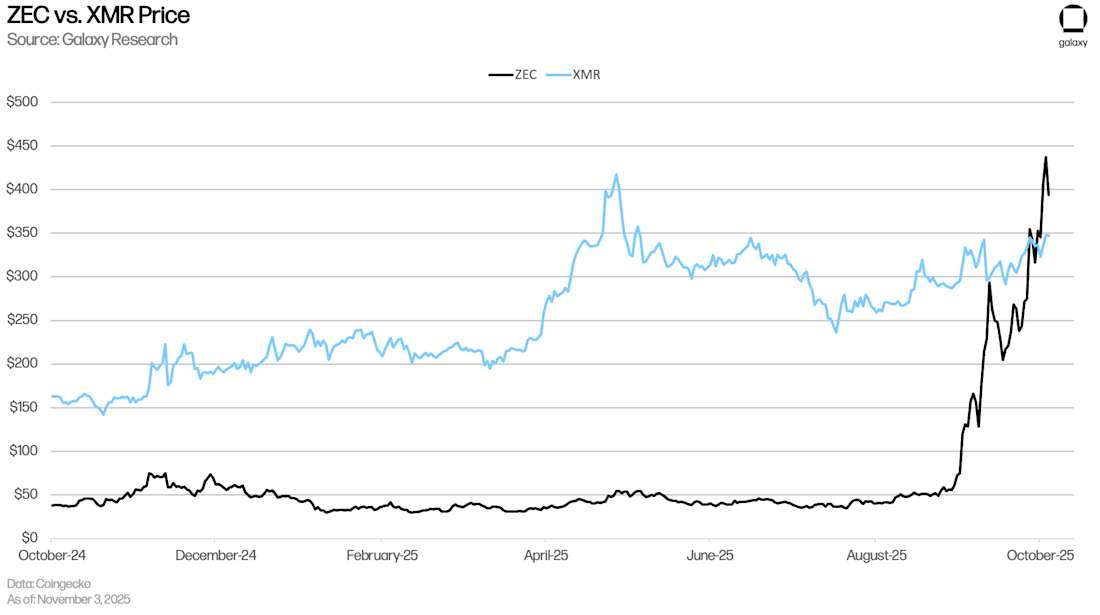
ZEC versus XMR over the past year.
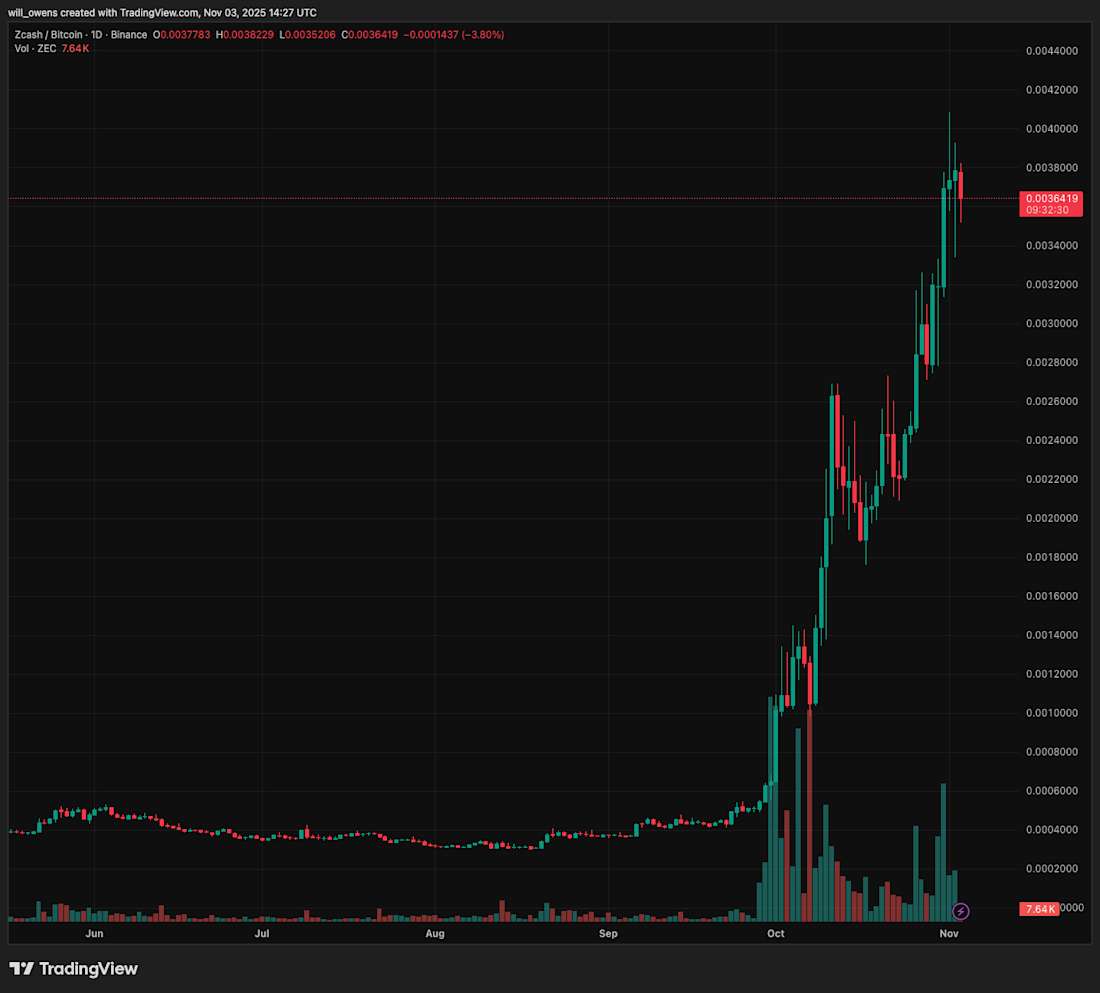
ZEC/BTC 1d chart, Nov. 3. This shows how ZEC is priced in BTC.
Technology
Zcash follows Bitcoin’s monetary design: a fixed 21 million ZEC supply cap, proof-of-work consensus, and an issuance rate that halves roughly every four years. It relies on the Equihash algorithm, which is designed to be more resistant to ASIC concentration than Bitcoin’s SHA-256. Blocks are produced about every 75 seconds (this is roughly eight times faster than Bitcoin’s 10-minute blocks). Zcash’s halving schedule aligns roughly every four years, with the next halving expected in November 2028 to reduce the block reward to 0.78125 ZEC.
Zcash utilizes two different address types: transparent or “t-addresses” which function exactly like Bitcoin as balances and transfers are publicly visible; and shielded or “z-addresses,” which use zk-SNARKs to hide sender, receiver, and amount while still proving that no new coins have been created.
When a user sends ZEC from one shielded address to another, instead of inspecting transaction details, the network checks a cryptographic proof. The proof essentially shows “I have the right to spend these coins, and the math adds up,” but leaks no unnecessary information. At the end of the day, that’s what privacy is all about: sharing only the absolute minimum information necessary to establish trust. The larger the shielded pool, the harder it is to trace flows. This is why the recent shielded pool size increase (over 30% of all ZEC is now shielded) is so significant. A bigger anonymity set equals stronger privacy. The largest shielded pool is called Orchard, and this one launched on May 31, 2022. It replaced older shielded pools like Sapling and Sprout with the Halo 2 proving system, eliminating the need for a trusted setup and introducing unified addresses to simplify privacy for users.
The Orchard shielded pool now hosts >4 million ZEC (~25% of total circulating supply) and the vast majority of the ~4.9 million shielded ZEC.
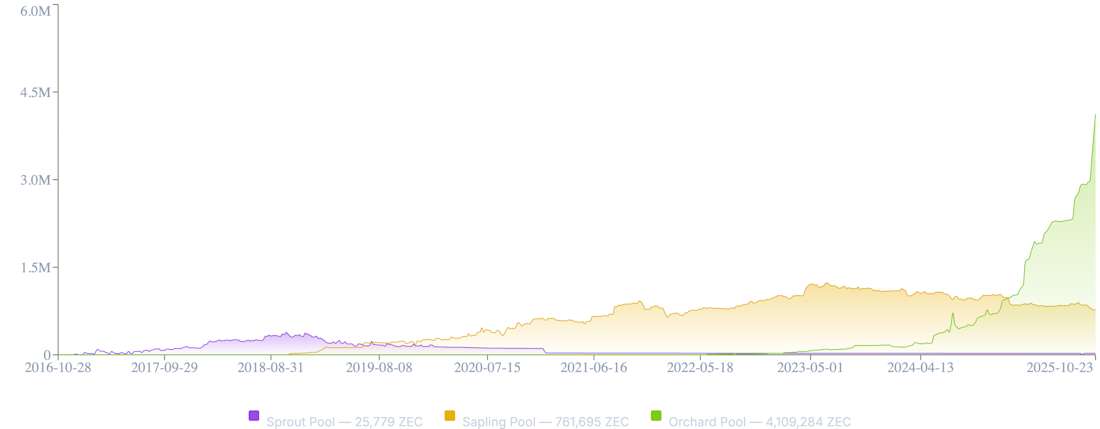
Shielded Supply, ZEC, Credit: https://zechub.wiki/dashboard
Transparent supply is down almost 3 million ZEC, from ~14 million at the beginning of this year to ~11.4 million now (~70% of total supply).
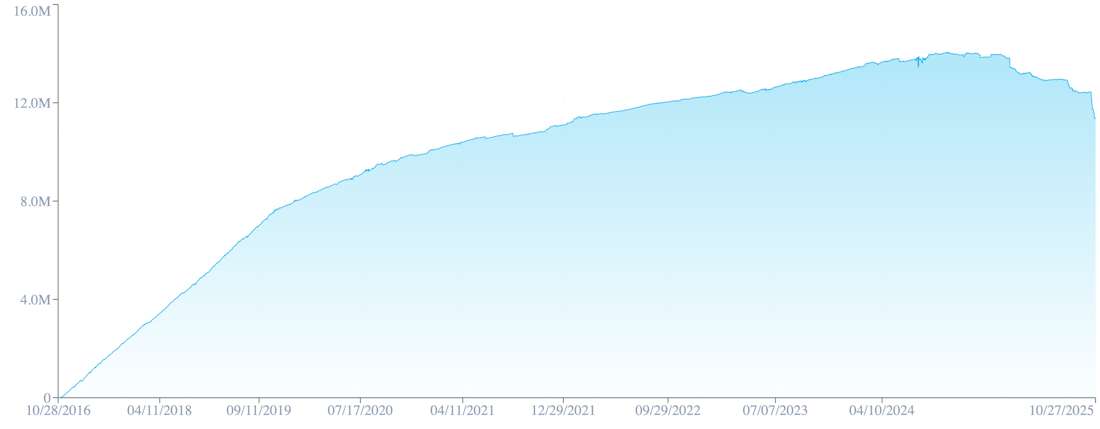
Transparent supply, ZEC, Credit: https://zechub.wiki/dashboard
The Zcash network currently maintains roughly 100–120 full nodes, up from lows near 60 earlier this year. This remains small compared with Bitcoin (~24,000 nodes) or Monero (~4,000), largely because it is significantly more resource-intensive to operate a Zcash node. Each shielded transaction must be verified using zk-SNARKs, which require more CPU and memory than Bitcoin’s standard signature checks. The network’s multi-pool architecture (Sprout, Sapling, Orchard) adds further complexity, and frequent network upgrades force node operators to update software regularly to remain compatible. It will be interesting to see how the node count continues to fluctuate over time, especially if this privacy “rotation” remains intact.
Looking ahead, developer Sean Bowe is working on “Project Tachyon”. This is a major scaling initiative that could dramatically improve shielded transaction throughput by re-architecting how Zcash handles synchronization and nullifier storage. Bowe has said Tachyon could enable large performance gains without introducing a new shielded protocol. He describes it as a way to solve “every bottleneck with relatively simple cryptography”. In effect, Tachyon could become to Zcash what Firedancer is to Solana.
What Are NEAR Intents?
NEAR Intents are part of a new cross-chain coordination layer built on the NEAR protocol. They allow users to express an intention (like “pay X amount of ETH to address y”) rather than manually managing bridges, swaps, or wallets.
Behind the scenes, intent executors (autonomous onchain agents) fulfill those instructions by routing liquidity, executing swaps, and settling across chains.
For Zcash, intents integration means that users can now move assets from transparent networks into Zcash’s shielded pools and back without exposing every step onchain. In practice, this allows a trader or institution to restore privacy by transferring funds from a visible blockchain (like Ethereum) into Zcash, conduct shielded transactions, and (if desired) return to the original chain with no direct link between the two addresses.
The integration of NEAR Intents into the Zashi wallet (the official Electric Coin Company wallet and the one most widely used in Zcash) abstracts away the technical friction of bridging and shielding for the user. Zcash also natively supports view keys, which enable selective disclosure of shielded transaction details for auditing or compliance purposes. Together, these features make privacy on Zcash both accessible to individuals and compatible with institutional requirements.
Why Now?
Zcash’s sudden +700% move appears to reflect broader cultural shifts within crypto. As highlighted in a16z’s 2025 State of Crypto report, Google search interest for privacy-related terms has surged in recent months.
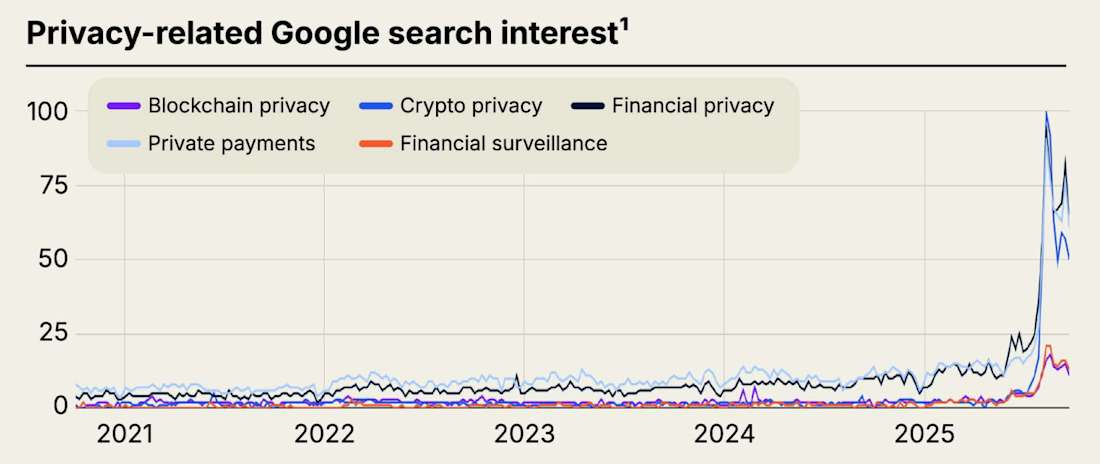
Many Bitcoin critics lament the “institutionalization” of Bitcoin, calling it “dominated by ETFs” and centralized custodians. Bitcoin itself has always been fully transparent; ETFs haven’t made it any less so, only more intermediated. Zcash’s advocates, by contrast, frame it as “encrypted Bitcoin,” a return to cypherpunk principles that resonate amid widespread onchain surveillance by everyone from analytics vendors like Chainalysis to social media sleuths (ZachXBT and Lookonchain, among others). Zcash’s rise has reopened an old philosophical divide between privacy as a right versus transparency as a regulatory necessity, a circle the project has long sought to square.
Zcash is gaining visibility as its privacy stack finally reaches consumer-grade usability. The Zashi wallet (launched in March 2024) abstracts away the complexity of the shielding UX and shielded supply is trending up right now. As more ZEC gets shielded, the anonymity set grows and allows Zcash to become more private.
In perhaps the clearest sign that Zcash is “so back,” Hyperliquid listed ZEC perps a few weeks ago, allowing traders on the popular decentralized exchange to take leveraged positions on the privacy coin. The move suggests strong community demand for exposure to a coin the market had ignored for years. The availability of perps has increased market liquidity for ZEC, with open interest around $115 million as of Oct. 30, and is contributing to greater spot price volatility.
Technically, Zcash’s fundamentals haven’t radically changed overnight. But the perception around the technology has. This rally is driven by both constant vocal support from some of crypto’s top voices and also a reminder of how important privacy is for permissionless money.
Whether ZEC’s price strength persists or not, this rotation has already succeeded in forcing the market to reprice privacy ($RAIL, $ARRR, $UMBRA are other crypto privacy project coins which have also seen strong bidding).
The rally has given Zcash renewed relevance after years on the sidelines. Whether it can translate speculative momentum into sustained network growth remains to be seen, but the renewed focus on privacy underscores a deeper point: in an increasingly transparent financial system, the ability to transact privately is once again being treated as a valuable feature.