

x402 is a payment protocol developed by Coinbase that addresses the HTTP 402 “Payment Required” status code to enable stablecoin payments by AI agents within API requests. This means an AI agent or human client can hit an API, receive a 402 response with price details, sign a micropayment in USDC and immediately retry the request, all without leaving the browser or app.
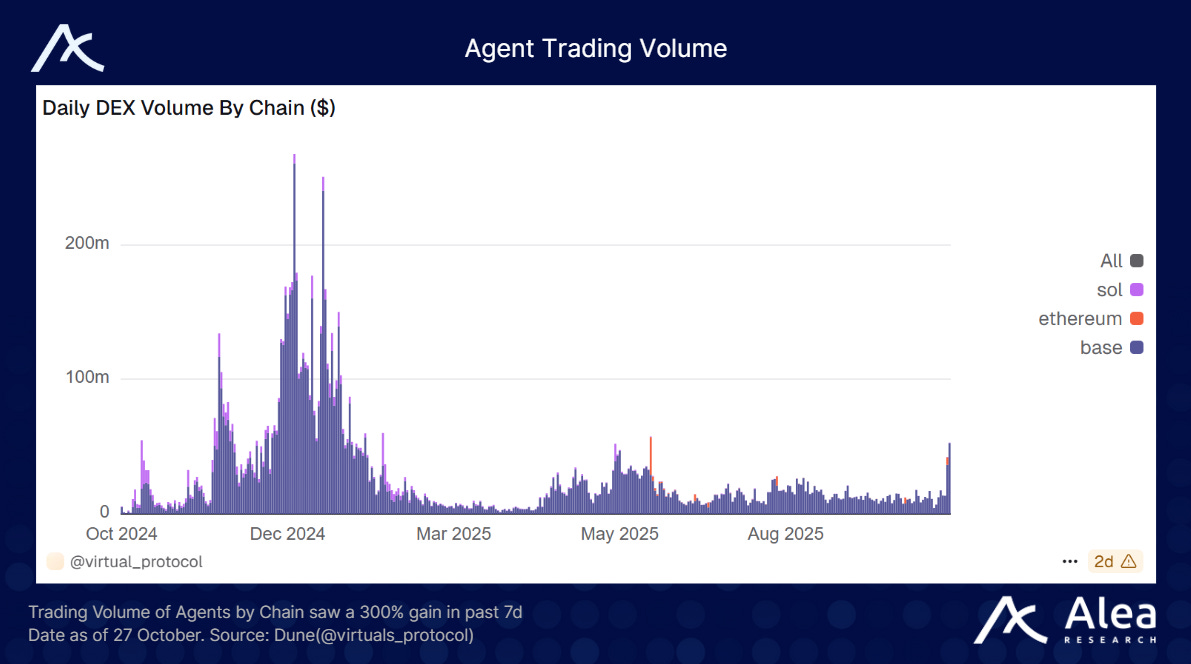
In this edition, we’ll look into x402’s mechanics, the surge in x402‑related tokens and infrastructure, and why agent platforms like Virtuals are seeing huge inflows in volume.

Primer - How x402 works
When a client requests an x402‑enabled service, the server returns a 402 with a price, a list of accepted tokens and a payment address. The client signs a payment authorization and returns the request which will then be validated by facilitators of that service and USDC payment is settled along with the requested data. Facilitators are currently operated by Circle and Coinbase with payments settled on Base in roughly 2 seconds.
Unlike credit‑card processors that charge ~2.9% + $0.30, x402’s protocol fee is zero with only paying gas, which is typically fractions of a cent on Base. This makes pay‑per‑request APIs and machine‑to‑machine (M2M) transactions economically viable down to $0.001.
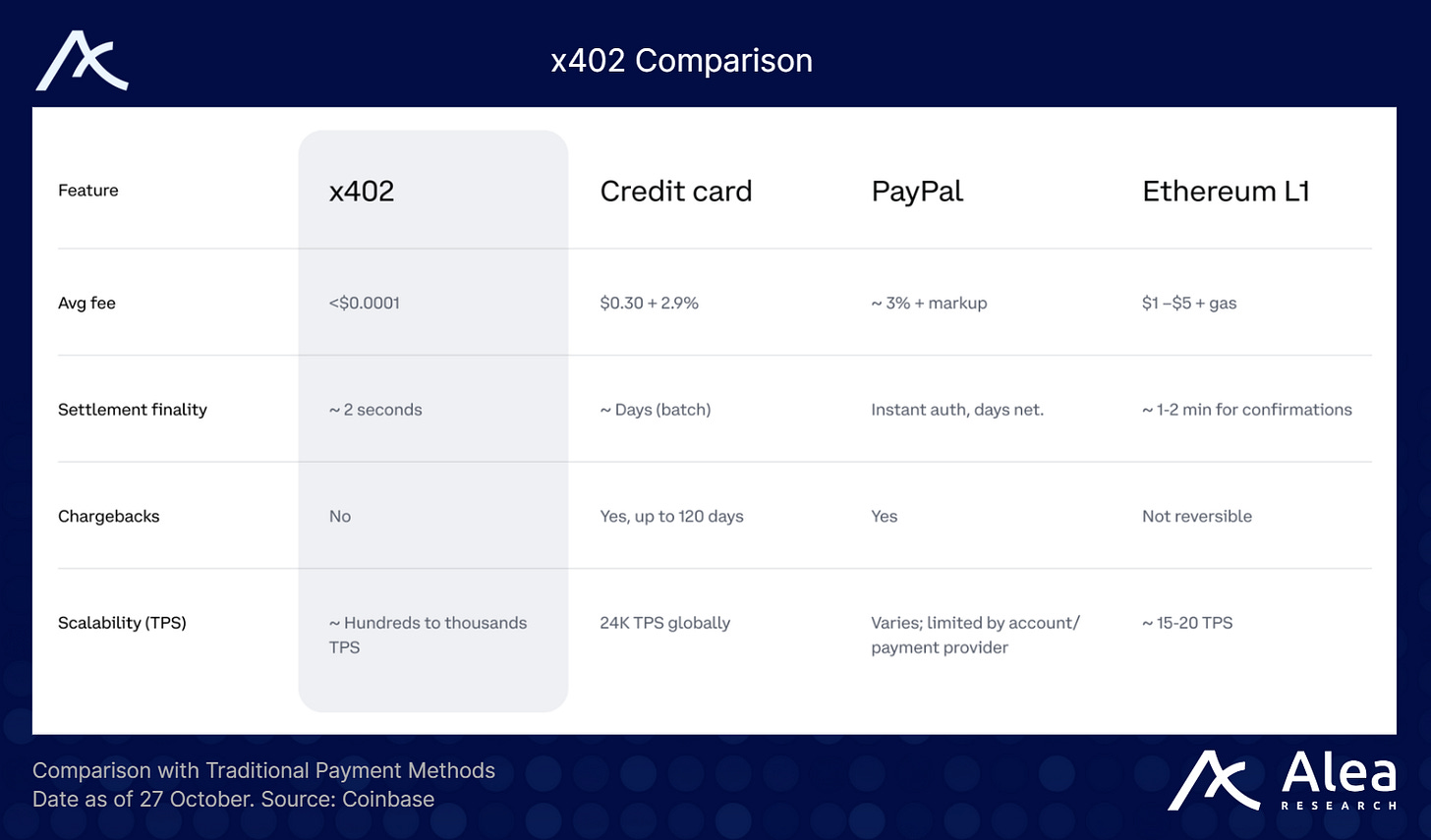
Because this protocol extends standard HTTP rather than creating a proprietary API, it works across browsers, SDKs and AI agents without requiring accounts or OAuth flows.
Thematic Context
x402 sits nicely between the intersection of the agentic economy and the Q4 24 - Q1 25 AI memecoin supercycle. Virtuals and Virtuals agents are seeing huge uptick in volumes as they get fitted with x402 capabilities.
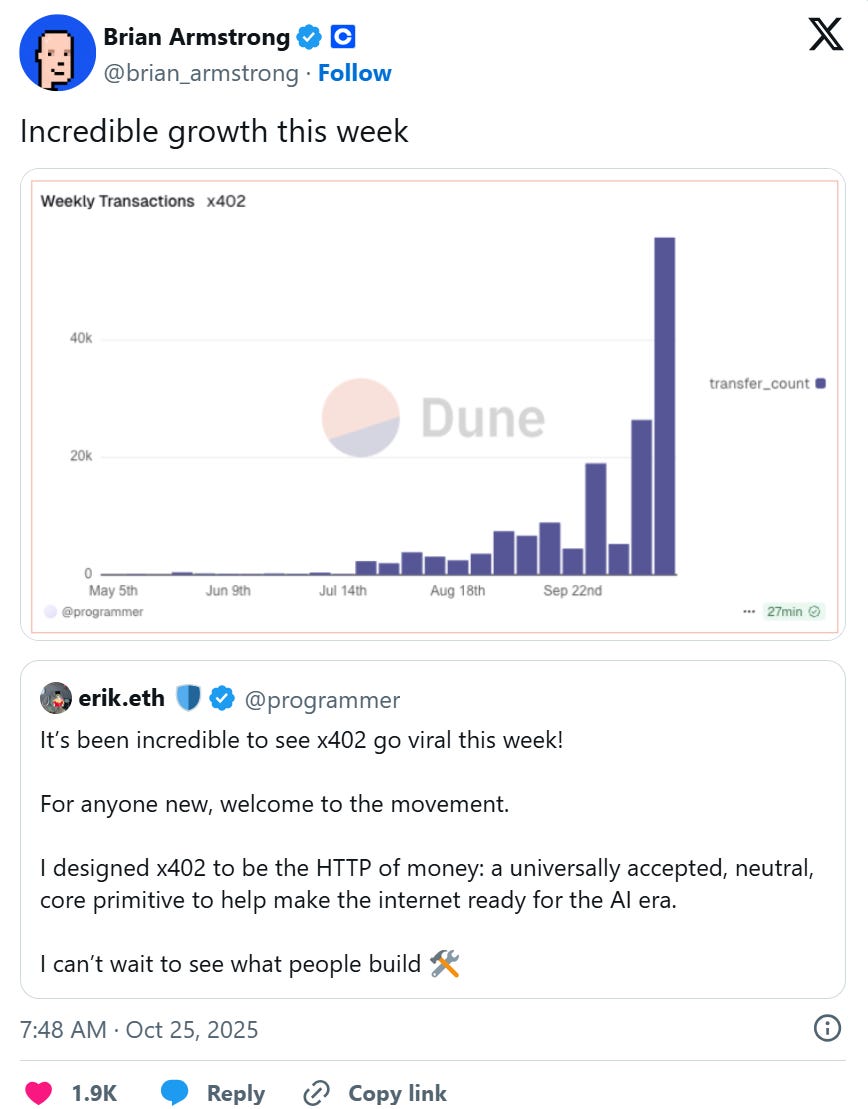
Adoption metrics have seen x402 transactions hit almost 1m just last week.
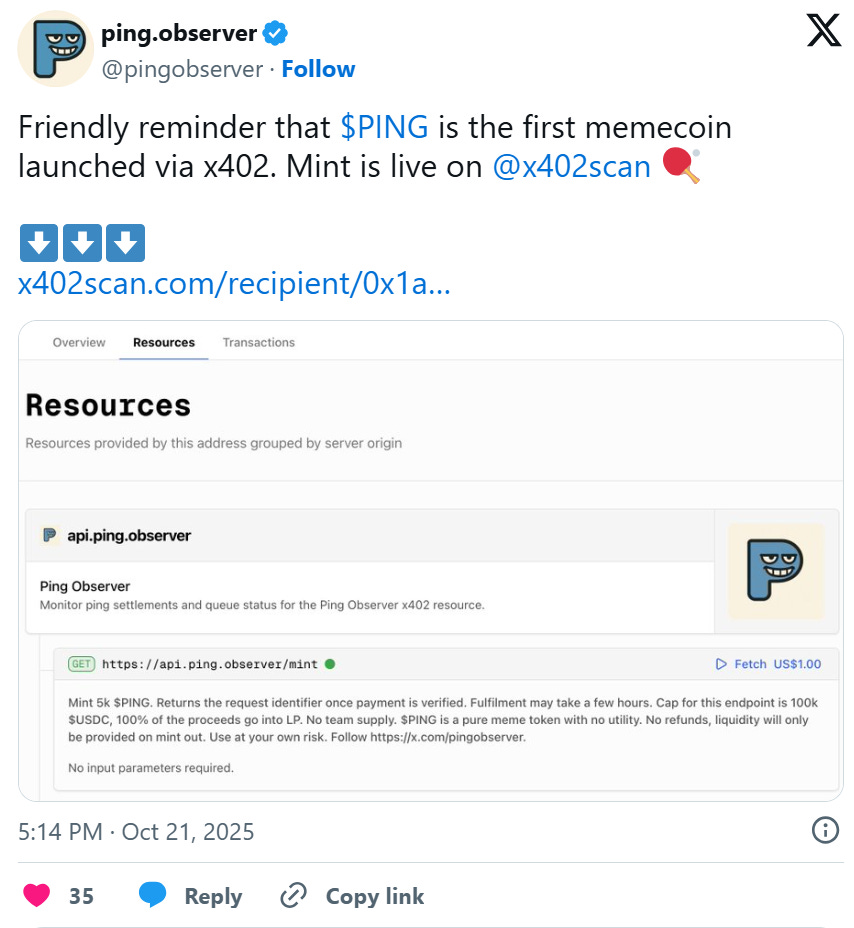
We also saw the rise of tokens like $PING which was minted via HTTP requests, reaching a marketcap of just over $70M.
For allocators, x402 offers exposure to a potential $30 trillion agentic economy. But it’s still relatively early as metrics like 500K weekly transactions and $800M market cap are tiny relative to global payments. The winners are likely to be platforms that combine payments, coordination and verification.
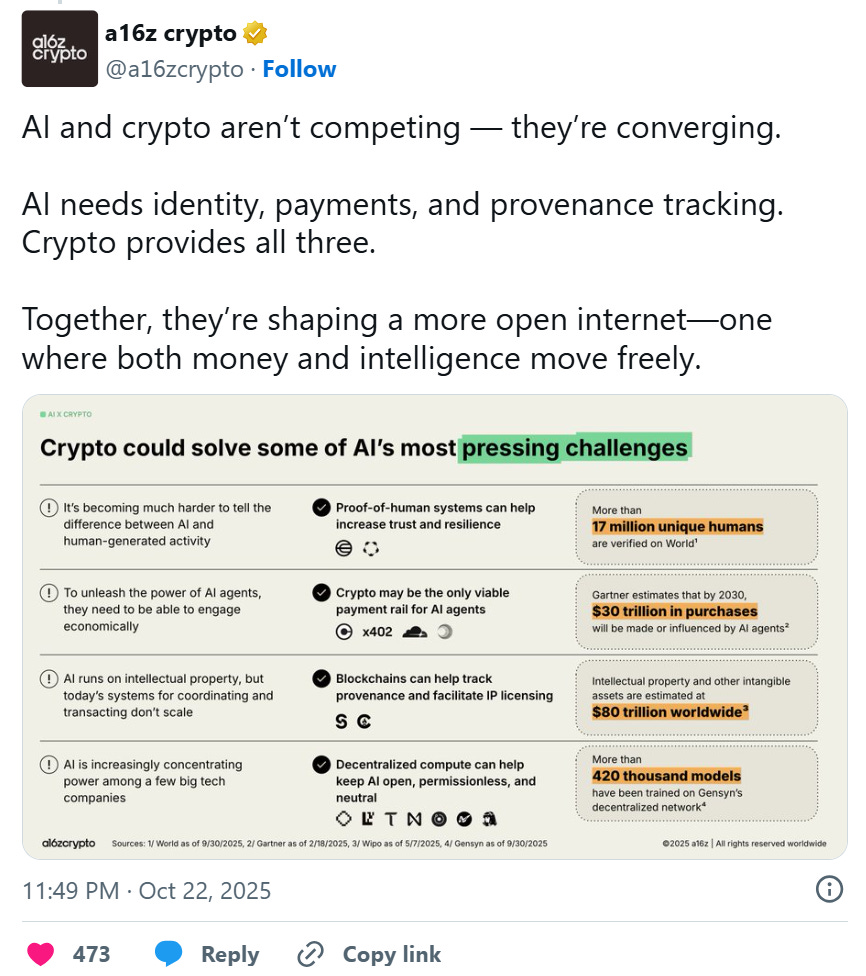
Boom in x402-related Projects
Virtuals has integrated its Agent Coordination Protocol (ACP) with x402 to handle escrow, verification and on‑chain settlement. We are seeing plenty of new and old agents adopt this technology to enable microtransactions within agent commerce.
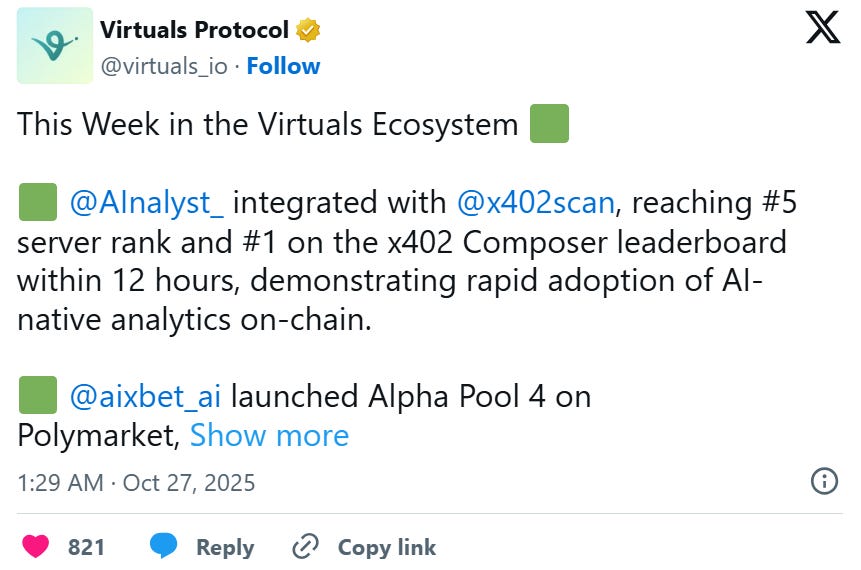
Some notable projects include:
- AIXBT - An older AI agent originally launched by Virtuals in November 2024, focuses on tracking crypto discussions on X to identify trending projects, metaverse initiatives, and market opportunities. They recently integrated x402 allowing users and other agents to query network data with pay-per-use micropayments instead of monthly subscriptions.
- GAME - Another established AI agent that specializes in gaming integrations, enabling agents like NPCs or assistants to handle play-to-earn mechanics and in-game transactions. It incorporates x402 to allow agents to make instant micropayments for services, assets, or compute within gaming ecosystems on Base.
- PAYAI - PayAI operates as a facilitator by settling x402 payments on Solana and EVM chains, handles gas fees and offers middleware. Previously this was only provided by Coinbase and Circle, but now PayAI processes over 14 % of x402 volume.
- Meridian - Meridian introduces receiver wallet architecture for x402 payments, which they term “Payment rails as a service”. Meridian’s goal is to create a standardized, interoperable system for AI-to-AI and AI-to-service payments, allowing agents to transact autonomously and frictionlessly across different platforms.
- Aurra Cloud - Serves as an AI agent infrastructure platform tailored for crypto-native applications, offering hosting, tooling, and monetization for agents, workflows, or APIs. It integrates x402 by providing gated inference as a service with over 200 AI models, enabling pay-per-use access via OpenAI-compatible APIs, smart wallets, and more.